
Delia Derbyshire: Symphony in BBC Minor
Written by Joséphine Coadou
Long kept in the shadows, Delia Derbyshire has nevertheless become one of the pioneers of modern electronic music. The craftswoman behind a now-iconic television theme and an tireless explorer of new sonic landscapes, she transformed everyday noises and magnetic tape into avant-garde works. Blending scientific rigor, artistic intuition, and a refusal to conform, her life tells the story of a woman who redefined what music could be in the twentieth century.
Coventry: Born, Bred and Blitzed
Delia Derbyshire was born on May 5, 1937, in Coventry, an industrial city in central-west England where her father worked as a laborer. From childhood, music was central to her life. She played the piano and passionately listened to Bach, Beethoven, and Mozart, but she was equally fascinated by the sounds produced by everyday objects.
Her early years were marked by a particular tone. In 1940, Coventry was heavily bombed by the Germans during Operation Moonlight Sonata. For her safety, she was sent north to live with relatives in Preston. The young Delia would remain deeply affected by the sound of air raids, echoes that later resurfaced in several of her works, such as Pot au Feu (1968), which evokes the wail of Blitz sirens intertwined with the footsteps of workers on cobblestones. It was a powerful choice: those sounds belonged to the collective memory of her generation. Years later, at a convention, a fan would jokingly greet her with, “Coventry: born, bred and blitzed!”
A brilliant student, she won a scholarship to study mathematics at Girton College, Cambridge. An opportunity rarely granted to a girl, let alone one from a working-class background. Yet her first love remained music. In 1958, she visited the Brussels World’s Fair and, in particular, the Philips Pavilion, where Edgard Varèse’s Poème électronique was being broadcast. The piece, combining breath-like sounds, percussion, and bell tones, fascinated her and intensified her interest in electronic music. The following year, she graduated with a Bachelor’s degree in mathematics and music.
After graduating, however, she felt somewhat adrift. What career should one pursue when interested in “sound, music, and acoustics” while possessing a mathematician’s mind? At Cambridge, career advisors were not particularly helpful; they suggested hearing-aid design or deep-sea sounding. Delia dismissed their advice and applied to Decca Records, which informed her that the company did not employ women in its recording studios.
While searching for better opportunities, she moved to Geneva, where she taught piano to the children of foreign diplomats, then worked briefly at the International Telecommunication Union and even tried teaching in Coventry.
One year after graduating, she finally secured a position as assistant studio manager at the BBC. She worked notably on Record Review, a program analyzing classical music recordings, where she was highly appreciated by her colleagues.
The Delia “DIY” System
What Delia truly wanted, however, was to create music: a difficult ambition, since the BBC did not employ composers. When she heard about the Radiophonic Workshop, an experimental department producing soundscapes and effects for BBC programs, she approached her superiors. They were perplexed: the Workshop was considered a dead-end posting; no one volunteered to go there.
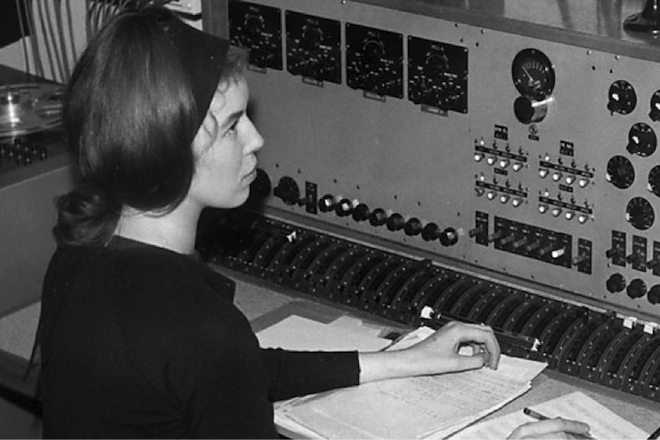
In 1962, she joined the Workshop at Maida Vale Studios in Westminster. She discovered that the team occupied just two small rooms and worked with extremely limited resources. No matter, she could finally make music.
As its first member with formal musical training, she helped usher in the Workshop’s golden age. On her first day, she noticed there was only one book in the room, devoted to frequencies. She flipped through it, took out a pencil, and began correcting the formulas. The anecdote reflects her analytical, even mathematical, approach to music. She treated compositions like images to be examined and retouched, each sound a shade of color applied to a canvas. She excelled at manipulating and reshaping sounds until they became something entirely new, creating magnetic tape constructions so complex that she sometimes had to stretch them down the corridors to inspect them properly. As programmer and composer Alan Sutcliffe observed, “To do mathematics, you have to be obsessed. You have to do things perfectly.” A credo that suited her perfectly.
The following year, BBC One launched a new adventure series blending science fiction and history, featuring an alien known as the Doctor traveling in a police box. Ron Grainer was commissioned to compose the theme, but it was Delia who realized it. She created the underlying rhythm from a single plucked string, recorded repeatedly at different pitches and speeds, gave the melody its otherworldly quality by modulating it through an oscillator, and crafted eerie swoops by splicing white noise.
When Grainer heard the final result, he reportedly asked, “Did I really write this?”
“Most of it,” Delia replied with an enigmatic smile.
Impressed, Grainer requested that she be credited as co-composer, but the BBC refused, preferring to keep Workshop staff anonymous.
The rest is well known: Delia’s arrangement became the main theme for the first 17 seasons of what would become the longest-running science-fiction series in television history and played a crucial role in popularizing electronic music in Britain. Naturally, she received no royalties, and her name was not formally acknowledged until the show’s 50th anniversary episode.
For eleven years, Delia created sound for nearly 200 television and radio programs, often with scientific, psychological, horror, or science-fiction themes. Those passing Room 13 at Maida Vale must have wondered about the strange noises emerging from within. Lacking synthesizers and adequate resources, it was pure improvisation: she had to produce the sounds herself before recording and manipulating them. One can easily imagine her striking a metal lampshade to achieve her favorite resonant clang, or leaving wine bottles at varying levels of fullness to produce shimmering tones.
Her ambitions extended far beyond the Workshop. Once tasked with producing television music using only animal sounds, she simply packed her bags and visited major zoos to record material. She quickly gained a reputation for achieving the impossible.
One of her greatest accomplishments was Blue Veils and Golden Sands, composed for a program about the Tuareg people. In it, she used her signature metallic lampshade sound and her own voice, modulated into a counter-melody for camels crossing the desert heat.
Although the Doctor Who theme remains her most famous work, the years 1964–1965 marked the height of her artistry. During this period, she collaborated with playwright Barry Bermange on several programs, including The Dreams, in which people described their dreams, and Amor Dei, exploring belief in God. These works blended electronic soundscapes with interviews in poetic collages. They also carried a social dimension, foregrounding the voices of “ordinary” people discussing profound topics such as the afterlife or the existence of God at a time when working- and middle-class voices were often stereotyped and simplified. The approach outraged many listeners.
Despite her growing reputation within the BBC, she was credited only under the vague mention “special sound by BBC Radiophonic Workshop,” as policy forbade individual recognition.
London’s Pioneers
Some critics considered her music too sensual and sophisticated for BBC audiences. Seeking greater creative freedom, Delia explored new horizons and helped establish private studios.
In 1966, she partnered with fellow Workshop member Brian Hodgson and Peter Zinovieff to found Unit Delta Plus studio. The trio presented their music at electronic and experimental festivals such as the Million Volt Light and Sound Rave, where The Beatles performed their only public rendition of Carnival of Light, an unreleased musique concrète piece. Paul McCartney even invited Delia to arrange Yesterday.
The group disbanded the following year, but Delia continued working with Hodgson and David Vorhaus at Kaleidophon Studio. Under the name White Noise, they released an album now regarded as a landmark of electronic music.
They also contributed to the Standard Music Library, supplying music for various television programs. Several of Delia’s compositions, released under the pseudonym “Li de la Russe” (a nod to her auburn hair), were used in The Tomorrow People and Timeslip, rival science-fiction series to Doctor Who in the 1970s.
Final Movements
By the early 1970s, however, Delia’s enchanted chapter was closing. The arrival of synthesizers standardized production methods, leaving less room for the hands-on sonic manipulation she loved, while the pace of work accelerated: torture for a perfectionist. Feeling unable to express her creativity freely, she left the BBC in 1973.
She briefly collaborated with Hodgson on film soundtracks, but her heart was no longer in it. She worked as a radio operator, in an art gallery, and in a bookstore before buying a house in Northampton, near Coventry, where she settled with her partner in 1980. She continued composing privately and accepted occasional projects but largely withdrew from public life.
In 2001, she returned briefly, collaborating with Pete Kember (Sonic Boom) on Synchrondipity Machine, a partnership she described as “from another generation.” She died a few months later of kidney failure at age 64.
After her death, hundreds of tapes and nearly a thousand papers were discovered in her attic and entrusted to the University of Manchester, where they are now used as teaching materials.
A little-known heroine of British electronic music, Delia Derbyshire created a singular musical aesthetic that shaped television and science-fiction programming for decades. She influenced artists such as Pink Floyd, Aphex Twin, and The Chemical Brothers.
But above all, Delia Derbyshire’s story is that of a woman who refused to be constrained by her gender or her social class, and who never compromised her artistic integrity.
 English
  French