
Hedy Lamarr: The Drawbacks of Beauty
Written by Joséphine Coadou

For International Women’s Day, we decided to highlight female figures underestimated by posterity, which, without entirely ignoring them, has sometimes perpetuated an overly simplified portrait. And what better illustration than the life of Hedy Lamarr, who alone embodies the curse placed upon women: being seen first and foremost as a body, to the detriment of their intellect.
When Hedy Lamarr is mentioned, one primarily thinks of the Hollywood actress whose breathtaking beauty inspired the characters of Catwoman and Snow White… but one often forgets that the radio signal transmission method she developed revolutionized the history of communications. Wi-Fi, Bluetooth, GPS… does that ring a bell? Here is a story (quite literally) worthy of a Hollywood film.
Desire and a Gilded Cage
Hedwig Maria Kiesler was born on November 9, 1914, in Vienna to Jewish parents who had converted to Catholicism. With a banker father and a concert pianist mother from Budapest’s bourgeoisie, the young girl lacked nothing and received a refined education. Her mother, in particular, nurtured her love of music and cinema.
At sixteen, however, Hedwig was already headstrong: she skipped school to present herself at Vienna’s Sascha Studios. She entered the film world thanks to Georg Jacoby, who cast her in her first two films: Geld auf der Strasse (1930) and Storm in a Glass of Water (1931). She was also hired by theatre director Max Reinhardt, who told the press she was “the most beautiful girl in the world.”
The young woman then moved to Berlin, then the capital of European cinema. She filmed with Carl Boese and Alexis Granowsky, even attracting the attention of The New York Times. But it was with Gustav Machatý’s Ecstasy (1933) that Hedwig truly entered posterity. She appeared fully nude and, most notably, performed the first female orgasm scene in cinema history. Presented at the Venice Biennale, the film was a huge success for both its innovation and its scandalous nature. Condemned by Pope Pius XII, it earned the young actress a sultry reputation she would carry for the rest of her life.
The disapproval was shared by her parents, who left the theater during the premiere and sighed with relief when, a few months later, Hedwig married industrialist Friedrich Mandl. It was a highly advantageous match: Mandl was Austria’s largest arms manufacturer and one of Mussolini’s main suppliers. The brunette beauty was forced to end her career — the legend goes that her husband tried to buy and destroy all copies of Ecstasy. Instead, she assumed the role of trophy wife when her husband entertained clients and foreign leaders — including the Führer, if her memoirs are to be believed. She sat quietly, a fixed smile on her face, while discussions of submarines, torpedoes, and strategy unfolded. These situations that inspired her famous line: “Any girl can be glamorous. All you have to do is stand still and look stupid.”
Before long, the gilded cage in which Friedrich kept her became unbearable. He forbade her from leaving, had her friends monitored… The couple divorced in 1937. Hedwig later recounted escaping by drugging a maid and stealing her uniform.
Free again, the young woman traveled to London, where she met Louis B. Mayer, vice-president of MGM. He offered her a contract, which she initially refused. Persistent, she boarded the Normandie with him and convinced him to hire her on her own terms. She arrived in New York with a seven-year contract with Hollywood’s largest studio in her suitcase.
The MGM Years
Mayer first sought a less Germanic name for her and suggested that of a recently deceased actress: Barbara LaMarr. She then spent six months learning English by watching films… and although her accent remained strong, everyone agreed she possessed remarkable beauty.
Now known as Hedy Lamarr, she began her Hollywood career with Algiers by John Cromwell, a remake of Pépé le Moko. She worked under the direction of great filmmakers: Victor Fleming, Clarence Brown, King Vidor, Jack Conway…
Gradually, her films shaped the image of an exotic and mysterious woman. She starred in Lady of the Tropics (1939), then played a charming Soviet agent in Comrade X (1940), before establishing herself as an untouchable beauty in Ziegfeld Girl (1941) — the image of Hedy descending the staircase, her face framed by stars, remains unforgettable.
The “Lamarr Technique”
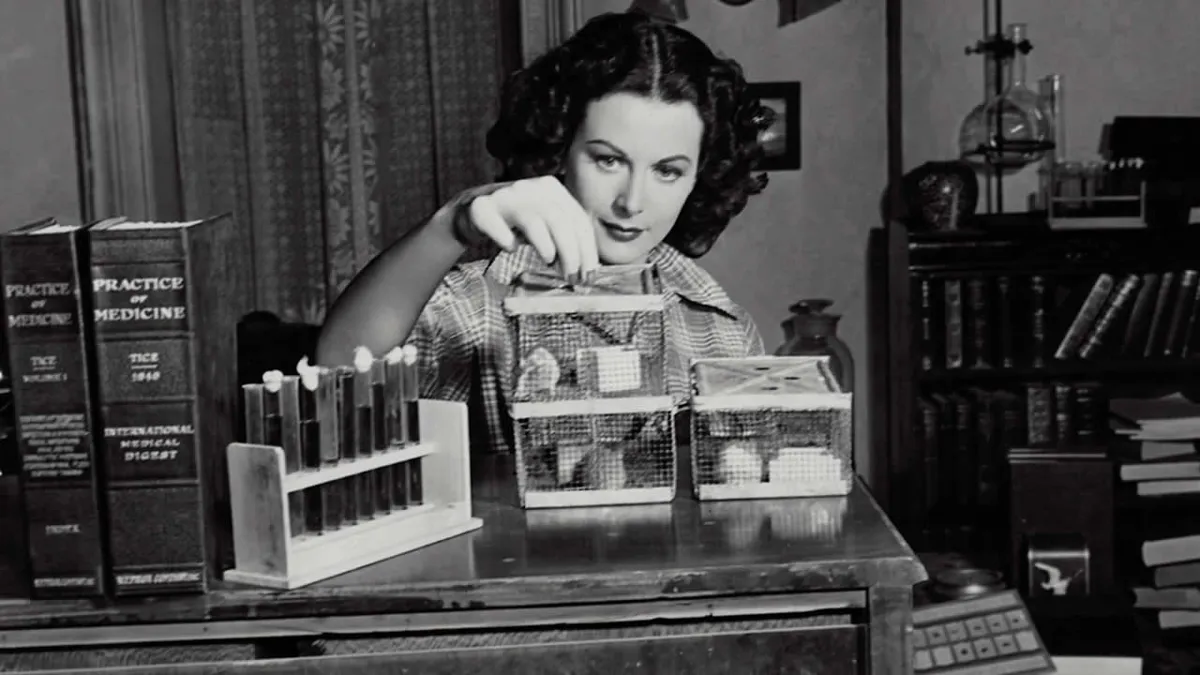
However, all was not rosy in La La Land. Hedy followed the advance of the Nazis with anxiety and, despite appearances, avoided frivolous parties, preferring instead to host dinners with intellectuals. The brunette beauty not only had an attractive face, but also an exceptionally sharp mind. In the evenings, after returning from film sets, she tinkered with various gadgets.
At one such dinner she met George Antheil, an avant-garde composer known for Ballet mécanique, written to be played simultaneously by sixteen self-playing pianos.
They spoke of music… but above all, of war. Drawing on conversations she had overheard at her first husband’s dinners, Hedy explained that American torpedoes consistently missed Nazi targets and that radio guidance was not feasible because signals would be intercepted.
Through discussions and piano improvisations, Hedy developed an idea: if the transmitter and receiver constantly changed frequencies in synchronization, the signal could no longer be intercepted.
And the astonishing part… it made sense. George helped refine and implement the idea. Working together in autumn 1940, they developed the principle of frequency-hopping spread spectrum. The final design used 88 frequencies, the number of piano keys. Hedy filed a patent, with George assisting in the paperwork, as she wrote largely phonetically — for the record, she had left school at sixteen and still spoke four languages…
She presented the invention to the military, which was intrigued but did not take her seriously. Being a beautiful woman did not help. The Navy shelved the idea and —just in case — classified it as top secret for 17 years. Moreover, because she had filed a patent, the invention became royalty-free for the U.S. Army, a principle reinforced by the Invention Secrecy Act of 1951.
Instead, the military suggested she support the war effort as a “pretty girl” should. Hedy boosted troop morale and sold war bonds — with remarkable success, raising $25 million. Meanwhile, she reinforced her image as a thriller heroine in The Conspirators (1944), a spy film by Jean Negulesco, and Experiment Perilous (1944) by Jacques Tourneur.
Yet the “Lamarr technique” was eventually used during the Cuban Missile Crisis in 1962 and later in the Vietnam War. Once declassified, the device was adopted by transmission equipment manufacturers. Her invention continues to shape modern life: frequency-hopping spread spectrum is still used today for encrypted military communications, satellite positioning (notably GPS), mobile telephony, Bluetooth, and Wi-Fi — among other technologies.
As you might expect, Hedy did not receive a cent. But she followed these developments closely — and with pride. She retroactively received the Electronic Frontier Foundation Award in 1997 and, with George Antheil, was inducted posthumously into the National Inventors Hall of Fame in 2014. Since 2005, her birthday, November 9, has been celebrated as Inventors’ Day (Tag der Erfinder) in German-speaking countries.
Twilight Years
After the war, Hedy grew increasingly dissatisfied with her acting career, tired of not being taken seriously and being confined to roles of mysterious, exotic femme fatales.
She experimented with different genres and even ventured into production with The Strange Woman (1946), a costume drama that gave her one of her most iconic roles: Jenny Hager, a schizophrenic criminal. She abandoned production the following year after the failure of Dishonored Lady.
She enjoyed one final success in the legendary Samson and Delilah (1949) by Cecil B. DeMille, cementing her image as the unattainable femme fatale.
Fatigue was compounded by changing beauty standards in Hollywood: curvy blondes like Marilyn Monroe… and above all, youth, came to dominate. As she approached forty, her looks, the only thing for which she had been valued, began to fail her. She gradually withdrew and left film sets in 1958.
Meanwhile, she collected romances (JFK, Charlie Chaplin, Marlon Brando, Robert Capa, Orson Welles…), married six times, and had three children. She consistently favored the same type of man: older, elegant, intelligent, and darkly handsome. According to her, “Below 35, a man has too much to learn, and I don’t have time to teach him.”
Then came the twilight years. Two decades spent in courtrooms between marriages drained her finances, and her relationships with her children were extremely conflict-ridden.
In 1966, Hedy Lamarr published her memoir Ecstasy and Me, recounting her romantic misadventures; the book is now ranked among the ten most erotic biographies of all time by Playboy. Upon release, it was even prefaced by a psychiatrist warning readers about the pathological libido of a woman of questionable virtue, further eroding her image as an untouchable goddess.
She briefly returned to public attention in the 1960s when she was prosecuted for shoplifting. Gradually, she slipped into anonymity and withdrew as her beauty faded. Obsessed with her appearance, she experimented with cosmetic surgery, with less than flattering results. When the Electronic Frontier Foundation honored her, she sent her son to accept the award rather than show her face.
“The most beautiful girl in the world” died in Casselberry, Florida, on January 19, 2000. Her obituary mirrored her life: it emphasized her extraordinary beauty while making no mention of her scientific contributions or her intellect.
And with these words, we call “cut.” We hope you enjoyed this article and that the next time you connect to Wi-Fi or use your Bluetooth speaker — meaning in less than two minutes — you’ll spare a thought for the extraordinary woman that was Hedy Lamarr.

