
Maryam Mirzakhani: When Curiosity Meets Mathematical Genius
Written by Sophie Gholami
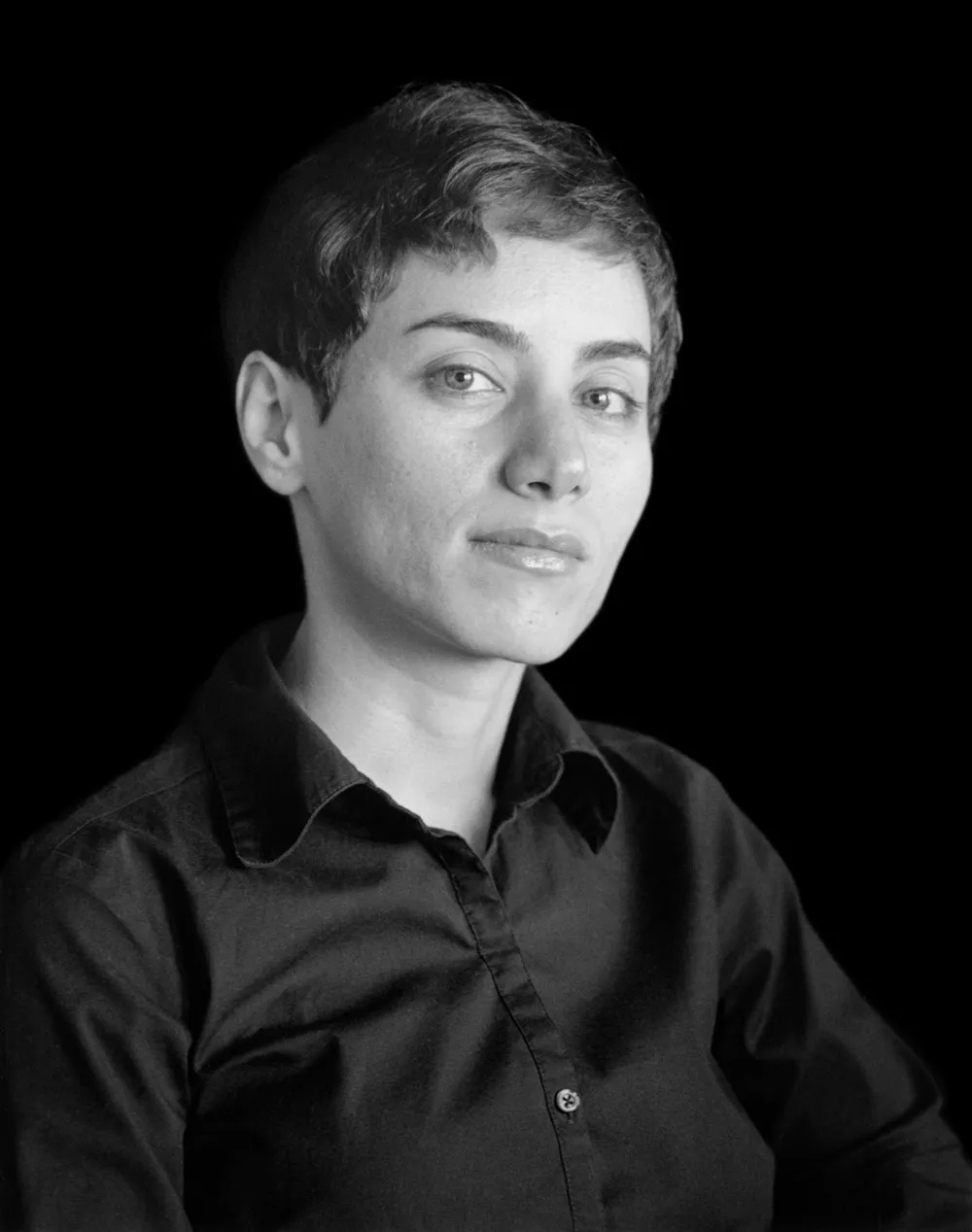
Despite representing a large share of university students worldwide, women remain underrepresented in mathematics. Persistent stereotypes still portray mathematical genius as rare and overwhelmingly male, discouraging many girls from pursuing the field.
To challenge these assumptions, we dedicate this article to Maryam Mirzakhani, the first woman to win the Fields Medal, the highest distinction in mathematics. Her work transformed our understanding of geometric spaces and opened new paths in modern mathematical research.
Maryam Mirzakhani was born in 1977 in Tehran, Iran. As a child she loved reading and once dreamed of becoming a writer. Mathematics only became a passion later, when she attended Farzanegan School, a school for academically gifted students.
Her talent soon became clear. In 1994, she won a gold medal at the International Mathematical Olympiad, becoming the first Iranian girl to achieve this distinction. The following year she returned and earned another gold medal with a perfect score.
After studying mathematics at Sharif University of Technology in Tehran, she moved to the United States to pursue a PhD at Harvard University under mathematician Curtis McMullen, a Fields Medalist himself.
Exploring the Geometry of Hidden Worlds
Maryam worked in geometry, a field of mathematics that studies shapes and spaces. She focused on very complex surfaces called Riemann surfaces, which can be imagined as curved shapes that mathematicians use to understand many advanced problems.
Instead of relying only on formulas, Mirzakhani often thought visually. She covered sheets of paper with drawings of curves and shapes while trying to understand how these surfaces behaved and changed.
During her PhD at Harvard University, she made remarkable discoveries. She found new ways to understand the “space of all possible shapes” of certain geometric surfaces, something mathematicians had struggled to analyze for decades. Her work revealed hidden patterns and helped connect several areas of mathematics that had previously seemed unrelated.
Her discoveries quickly gained international recognition. After completing her PhD in 2004, she became a professor at Princeton University, and later at Stanford University.
In 2014, she received the Fields Medal for her groundbreaking work on the geometry of these complex surfaces. The award was historic: since its creation in 1936, no woman had ever received the Fields Medal. Her achievement was celebrated not only for its scientific importance, but also as a powerful reminder that mathematical brilliance has no gender.
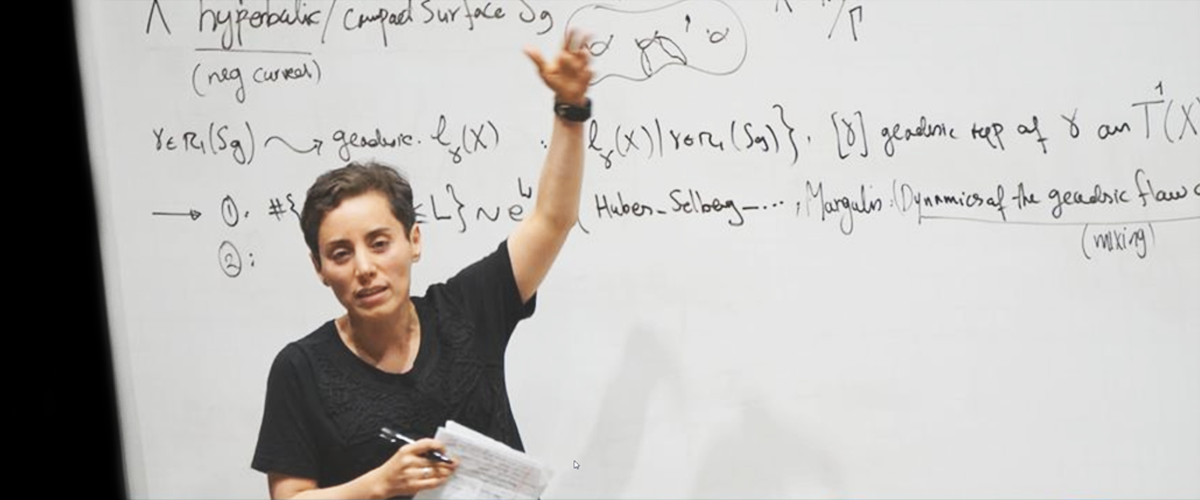
Why tell the story of Maryam Mirzakhani?
Because representation matters in disciplines that often seem inaccessible or intimidating.
For decades, mathematics was portrayed as the domain of solitary male geniuses. Mirzakhani quietly dismantled that myth, not through activism or speeches, but through the power of her work.
Perhaps even more inspiring is how she approached the discipline itself. Mirzakhani often compared mathematical research to solving a puzzle or exploring a landscape, a slow process of wandering, getting lost, and gradually discovering patterns.
She once explained:
“You have to spend some energy and effort to see the beauty of math.”
Today, scholarships, conferences, and even a day of celebration, May 12, the International Day of Women in Mathematics, commemorate her legacy.
Maryam Mirzakhani died in 2017 at the age of 40, after a battle with cancer. Despite her short career, her work reshaped several areas of modern mathematics and continues to influence researchers today.
Her story reminds us that mathematics is not just about formulas, it is about curiosity and persistence, and thanks to Maryam Mirzakhani, that landscape is now open to many more explorers. She proved that curiosity and perseverance can reshape entire fields of knowledge.

